
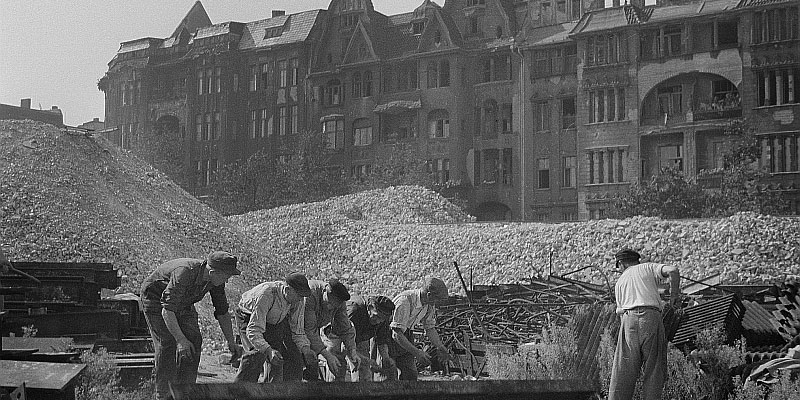
Economic history, from the end of the reconstruction period—that is, since 1950—is profoundly different from that of the interwar period. Industrialized capitalist countries have experienced, for more than fifteen years, a very rapid rate of growth, and the recessions recorded bear no comparison with the cyclical movements of the nineteenth century or the catastrophic depression of the 1930s. The acceleration of growth and the reduction in the amplitude of fluctuations are the two essential characteristics of postwar economic development. Western European countries have been the main beneficiaries of this improvement, and recessions have been marked only by a slowdown rather than a reversal of the trend. In most Western countries, annual indices of total and industrial production continue to grow—though more slowly during the recessions of 1951–1952 and 1958. The United States and Great Britain constitute an exception, but the scale of the downturn remains very limited compared with what had been experienced in the past.
The Rate of Growth
Reports from the OECD and the United Nations constitute a rich source of information on the history of growth and development since the war. Nevertheless, the fundamental work of Angus Maddison will serve as the basis for analyzing the main stages of economic growth in capitalist countries. While between 1913 and 1950 average annual growth rates declined under the influence of the two world wars, the period after 1950 shows a clear reversal. Before 1914, the United States and Canada led the capitalist world and retained first place with rates of 2.9% and 2.8%, respectively, between 1913 and 1950, despite the disruptions caused by the wars—unlike European countries. After 1950, the situation changes: between 1950 and 1960, only Belgium and Great Britain recorded lower average annual growth rates than the United States, which fell to ninth place in this growth race.
This period was marked by reconstruction efforts that created investment opportunities and accelerated growth. Between 1956 and 1961, some countries experienced slight slowdowns, but Denmark, Italy, Sweden, and Switzerland grew at faster rates than during 1950–1960. From the end of the war, two distinct groups of countries emerge: one with rapid growth, the other with weaker growth and greater sensitivity to recessions. West Germany and Italy lead the first group, although rankings vary between the two periods examined. During 1950–1960, Germany leads with 7.6%, followed by Italy with 5.9%, then Switzerland (5.1%), the Netherlands (4.9%), France (4.4%), Canada (3.9%), Norway (3.5%), Denmark and Sweden (3.3%), the United States (3.2%), Belgium (2.9%), and Great Britain (2.6%). Between 1956 and 1961, Italy moves into first place, followed by Germany, Switzerland, and Denmark, while France remains fifth after overtaking the Netherlands.
Alongside these rapidly growing countries, the United States, Canada, Belgium, and Great Britain display relatively weak growth rates, below the overall average. Between 1956 and 1961, their average annual growth rates fall below the levels recorded between 1870 and 1913. However, like the faster-growing countries, they avoided catastrophic depressions—this being a major novelty of the postwar period. These results were achieved in a context of significantly increasing total populations and relatively stable active populations, except in West Germany due to the labor supply provided by Eastern refugees.
Productivity growth also played a decisive role. For the twelve Western countries studied, productivity increased by 3.5% annually between 1950 and 1960. Notably, productivity growth in the United States remained stable at 2.4% across the three periods examined. European countries—except Great Britain and Belgium—experienced faster productivity growth than the United States, reflecting a parallel trend between output growth and productivity gains.
It is important not to confuse these growth rates with absolute values. The productivity of American industry remained significantly higher than that of European industry, largely due to economies of scale. Finally, the evolution of per capita output between 1950 and 1960 confirms the overall pattern: Germany and Italy lead, while the last four countries are Belgium, Great Britain, the United States, and Canada. Nevertheless, Great Britain and Belgium, with increases of 2.2% and 2.3%, are not far from the European average and share with other European countries the fact that they had never previously experienced such high per capita growth rates. In contrast, the United States and Canada had already experienced higher per capita growth at the end of the nineteenth century and up to 1950 than during the 1950–1960 period.