
The depression of 1929–1933 had multiple causes unrelated to the international monetary system itself. It nevertheless became an additional factor in that system’s collapse. From September 1931 onward, the breakdown of the gold exchange standard deprived debtor countries of means of payment precisely when their incomes were shrinking. A simple return to a pure gold standard would not have ensured a greater supply of credit for the countries most severely affected. What was required was international cooperation, yet such cooperation did not materialize. The attempts undertaken at the London Conference of 1933 ended in complete failure.
After Great Britain abandoned the gold standard, “monetary blocs” emerged. A large number of countries followed sterling, maintaining a fixed exchange rate between their currencies and the pound. As before, they held their international liquidity reserves in the form of assets deposited in London banks. Thus arose the sterling area. In reality, during the nineteenth century many gold-standard countries had already belonged informally to this sterling-centered system, which at times encompassed nearly the entire world. In contrast, the countries of the “gold bloc”—France, Italy, Poland, Belgium, the Netherlands, and Switzerland—attempted for as long as possible to defend the gold standard.
The United States adopted an ambiguous position. On 20 April 1933 it devalued the dollar after suspending the free convertibility of gold, and on 3 January 1934 it formally restored the gold standard. The Gold Reserve Act effectively devalued the dollar by raising the official gold price from 20.67 dollars per ounce to 35 dollars per ounce. Between April 1933 and January 1934, the dollar had floated. Numerous Central and South American countries linked their currencies to the dollar, forming what became known as the dollar area. This zone emerged at a moment when the sterling area was losing some of its members.
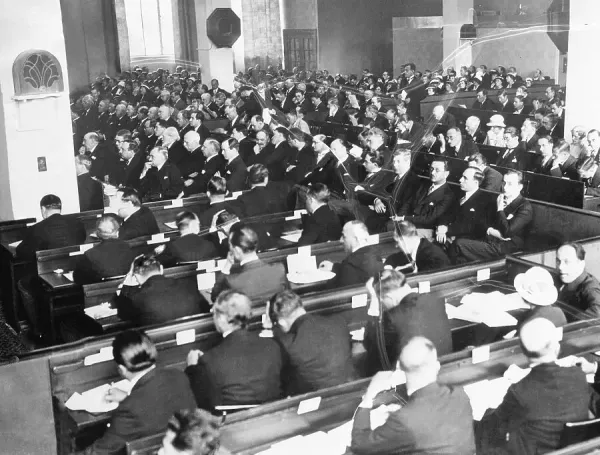
Amid uncertainty over the future of the dollar, a World Economic Conference convened in London in June and July 1933. Delegates from sixty-six countries debated the depression and monetary instability. The United States, France, Italy, and the Netherlands regarded a return to the gold standard as desirable. Great Britain and the sterling bloc, however, attached three major conditions to any such return: first, a rise in world prices; second, the removal of obstacles to international trade and a reduction of tariffs; third, an international agreement aimed at economizing gold and organizing cooperation among central banks. The gold bloc expressed its preferences, but the achievement of these objectives would have required coordinated policies that proved unattainable.
At a preparatory conference in Geneva the previous year, experts had formulated recommendations that appear striking in light of the prevailing conditions. They emphasized that revenues and expenditures, not only of state budgets but also of public enterprises and other public entities, should be balanced through recourse to monetary and capital markets, avoiding any inflationary expansion of note circulation intended to cover government deficits. They also appealed to Great Britain, warning that years of global disruption had produced a dense network of restrictions amounting to economic warfare. Durable reconstruction, they argued, required an end to this confrontation among national economies. Action in economic relations depended on monetary and financial measures, and progress in one sphere required parallel advances in the other.