
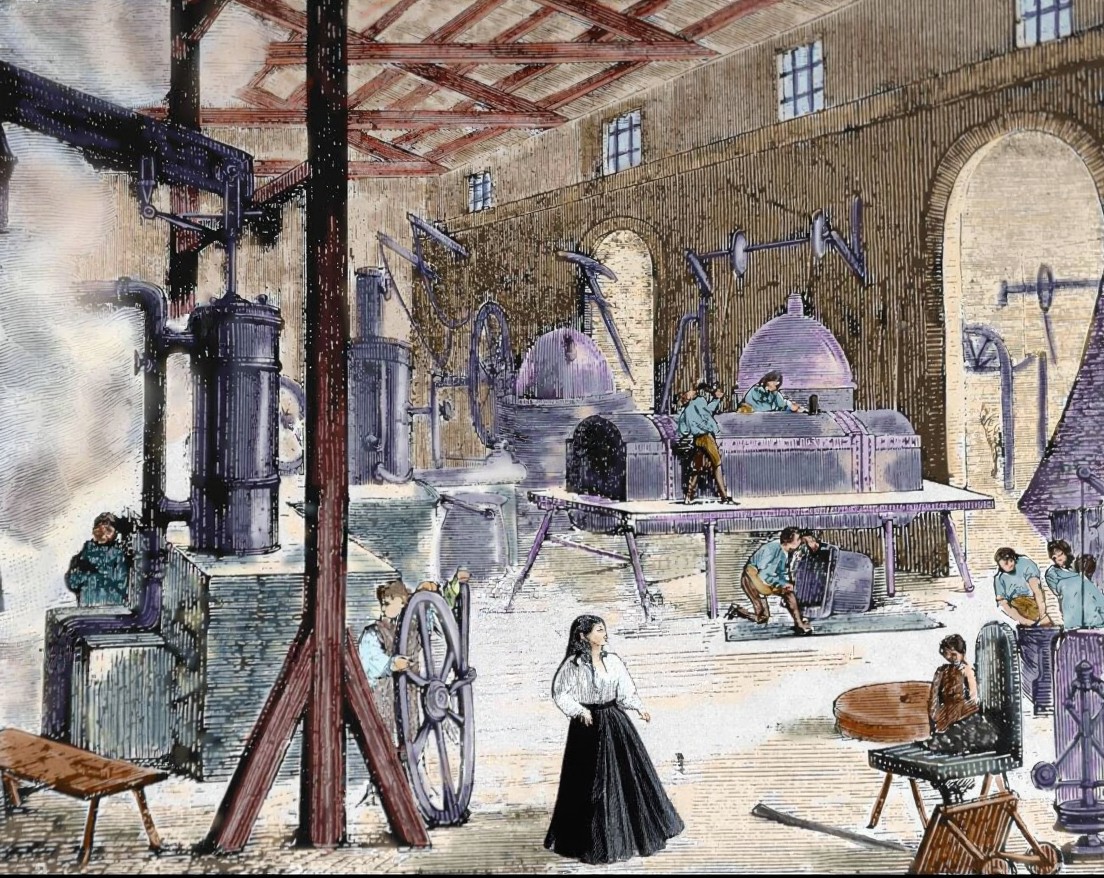
Industrial capitalism was born in England between the late 18th and early 19th centuries. To describe this period of profound changes in the economic and social orders, many authors speak of the “industrial revolution.” Arnold Toynbee was one of the first to use this expression in his Lectures on the Industrial Revolution in England, published in 1884. However, John Stuart Mill in his Principles and Karl Marx in Capital had already spoken of the “industrial revolution.” In chapter XV of Capital, first book, Marx writes: “When John Wyatt in 1735 made known his spinning machine and, with it, the industrial revolution of the eighteenth century, he did not say a single word about man being replaced as a motor by the donkey, and yet it was the donkey that assumed this role.” Is it not from the economic history of Great Britain that Marx has drawn his elements of analysis? His study describes the capitalist mode of production and the relations of production and exchange that correspond to it. England is the classic place of this production. This is the reason why I draw from this country the main facts and examples that serve to illustrate the development of my theories… “The country that is most developed industrially shows to those that follow it on the industrial scale the image of their own future.”
Cradle of industrial capitalist society, England offered Karl Marx a privileged field of observation on which he could base his doctrine. By a strange paradox, nascent capitalism inspired in the mind of the greatest thinker of the 19th century the conceptualization of the collectivist system. But in both systems, development passed through industrialization, whose starting point must be sought in British history. Although controversies may arise over determining the dates that frame the industrial revolution, we will admit with Paul Mantoux and T. S. Ashton that the beginning of the reign of George III and the beginning of the reign of his second son, William IV, in 1830, mark the passage from an artisanal economy to an industrial economy. The Victorian era (1837–1901) would see both the development and the apogee of the English economy, archetype of the capitalist system, which inspired Marx as much as Adam Smith, Ricardo as much as Malthus.
It thus took more than half a century for the revolution in the process of capital accumulation and in production methods to take place. This span of time may seem excessively long for a “revolution,” but relatively short in regard to the transformations that accompanied it. The difficulty lies in discovering the cause-and-effect relationships.