
General trends
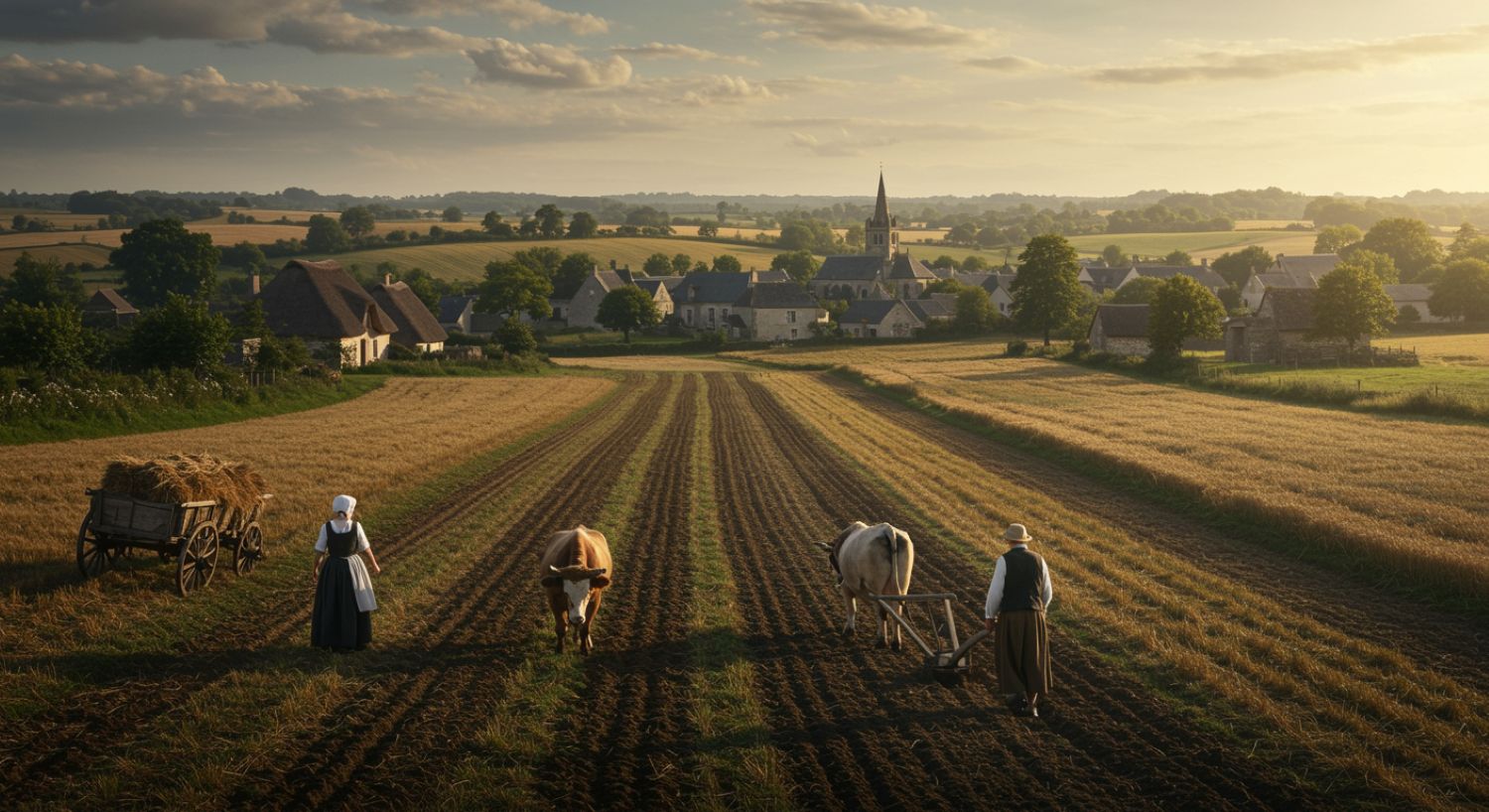
Unlike England, France did not experience the “enclosure revolution” and did not benefit from a significant increase in agricultural productivity since the sixteenth century. Henri Sé affirms in his Histoire économique de la France that the slow development of agriculture “was mainly due to the limited resources of the peasants who, in France, were the only investors in the countryside and on whom both the seigneurial regime and the royal treasury imposed taxes.” The insufficiency of transport infrastructure, the serious difficulties in moving products across provinces, and strict crop regulations were additional barriers to agricultural development. Orders existed that forced peasants “to plough and sow their lands by the ordinary rotations and seasons, namely, one-third wheat, one-third barley or oats, and one-third fallow.” Each region attempted to meet its needs through polyculture, making specialization impossible. All this was unfavorable to productivity, and it was not until the second half of the nineteenth century that French agriculture began to progressively free itself from the archaism of its production methods.
The Revolution of 1789, without excessively altering the structure of agrarian property, reinforced small and medium landholdings thanks to the sale of national assets. Large estates coexisted in France alongside small ones, but statistics fail to adequately reflect the distribution of agricultural property. Under the Restoration, a bill dated February 10, 1826 attempted to reestablish the right of primogeniture, but it met opposition, and land continued to be divided through inheritance. Agricultural property already suffered from fragmentation unfavorable to technical progress, and large landowners showed far less interest in improving production methods than their British counterparts. “The country gentleman farmer, already an exception under the Ancien Régime, did not reappear once courtly life ceased to be the supreme goal of the nobility. The nobleman personally managing his estate, the hobereau, was virtually unknown in France… Large landownership never considered agricultural progress as its own responsibility. The nobility preferred to lease out its lands, not in the form of large estates capable of high yields, as in England, but in small parcels, even in areas of vast holdings. Since their properties were often insufficient, peasants were eager to expand them through tenancy… This was the price paid by the Revolution for having limited itself to social reforms while leaving unresolved the technical problem of land consolidation.”
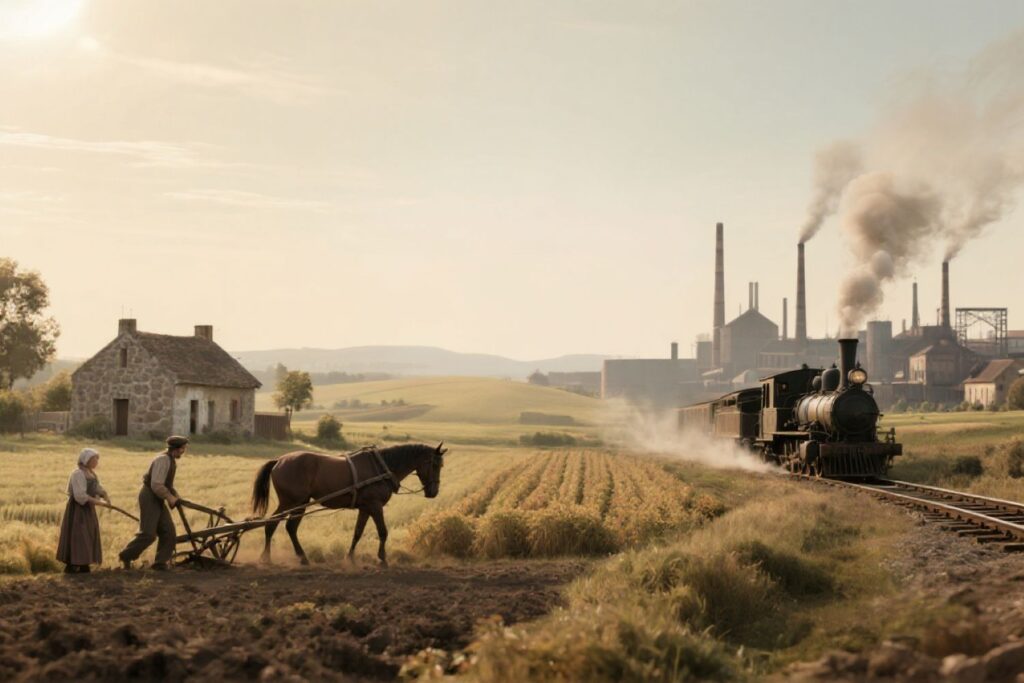
The delay of French agricultural progress, compared with the English experience, was unfavorable to industrialization. Remaining essentially agrarian during the first half of the nineteenth century, the French economy was slowed in its industrial development. “At the beginning of the twentieth century, France continued to be essentially a country of peasants. Large industrial concentrations existed only in the North and in some isolated areas.”
History of contemporary economic events
Regions in which at least 50% of the male active population was employed in agriculture still constituted the majority. This gave France a unique character: at a time when commerce and industry held a predominant role in all the great powers, France remained an essentially agrarian country, where peasant landowners played an important role. The rural population represented 75.6% of the total population in 1846, 69.5% in 1866, and 57.9% in 1906. Urbanization occurred in France as elsewhere in Europe, but less intensely. The relative importance of the agricultural population decreased more slowly in France than in England. It is estimated that in 1700, the population living off agriculture (not the entire rural population) represented between 80% and 85% of the total population; by the early nineteenth century, it was 75%, and by 1880 around 65%. These figures, although imprecise, illustrate the structure of the total population but not the active labor force. Only beginning in 1851 did censuses allow closer study of the active population, offering a clearer picture of the country’s economic structure.
In 1851, 64% of the active population was employed in the primary sector (agriculture, forestry, fishing) compared with only 45% in 1896. Agriculture provided 40% of national income at the beginning of the nineteenth century, 36% around mid-century, and 27% by 1900. The lag in agricultural productivity compared with industry becomes evident when comparing the share of the active population employed in agriculture with the share of national income derived from it. The contrast with England’s pace of industrialization is striking: around 1800, 35% of England’s active population worked in agriculture, producing 32% of national income; by 1851 these percentages had dropped to 21.7% and 20.3%, and by 1901 to 8.7% and 6.4%.
Stages of agricultural growth
To define the main phases of agricultural output growth, we draw on the work of J. C. Toutain. Statistical surveys—despite their margins of error—provide a more accurate view of the real progress of production than qualitative descriptions.
From the mid-eighteenth century until the First World War, four major periods can be distinguished, each characterized by different growth rates:
a) 1750–1760 to 1815: growth begins but loses strength;
b) 1815–1824 to 1855–1864: rapid growth;
c) 1865–1874 to 1885–1894: slow growth;
d) 1895–1914: renewed growth.
This division is necessarily approximate, and the dates should not be seen as strict turning points equivalent to cyclical phases. Most authors estimate that the beginning of agricultural development occurred around the mid-seventeenth century. Only after 1750 did French agriculture slowly revise work methods unchanged since the Middle Ages. It is no coincidence that during this period we find Quesnay and the physiocratic school promoting the virtues of agricultural development. The Tableau économique, published in 1758, was a major success, and Mirabeau became an effective propagator of Quesnay’s ideas. The theory of “net product” provided the analytical foundation of physiocratic thought, which held that wealth derived from agriculture.
Turgot liberalized the domestic grain trade, with favorable effects on production and prices. Tocqueville wrote in L’Ancien Régime et la Révolution: “About thirty or forty years before the outbreak of the Revolution, the spectacle began to change… Each year this movement spread and accelerated; finally, the whole nation stirred and seemed to be reborn… As these changes affected both rulers and the ruled, public prosperity developed at an unprecedented pace. All the signs were evident: population growth, wealth multiplying even more rapidly.”
English influence was felt, and in France methods previously adopted in Britain were introduced: the suppression of fallow fields, replaced by artificial forage crops; improved livestock breeding; expansion of cultivable land through clearing and drainage of marshes. But this advance would stall on the eve of the Revolution. Despite agricultural growth, the conditions of the vast mass of poor peasants had not improved. The new ideas reached only a small elite, and absentee landownership was widespread. The average annual growth rate, which had reached 1.35% between 1760 and 1780, slowed at the beginning of the nineteenth century. Nevertheless, between 1750 and 1812 agricultural output increased faster than total population. The worst period occurred between the fall of the Empire and 1824: population growth was weak, while agricultural output growth was almost nil. Productivity even declined during this same