
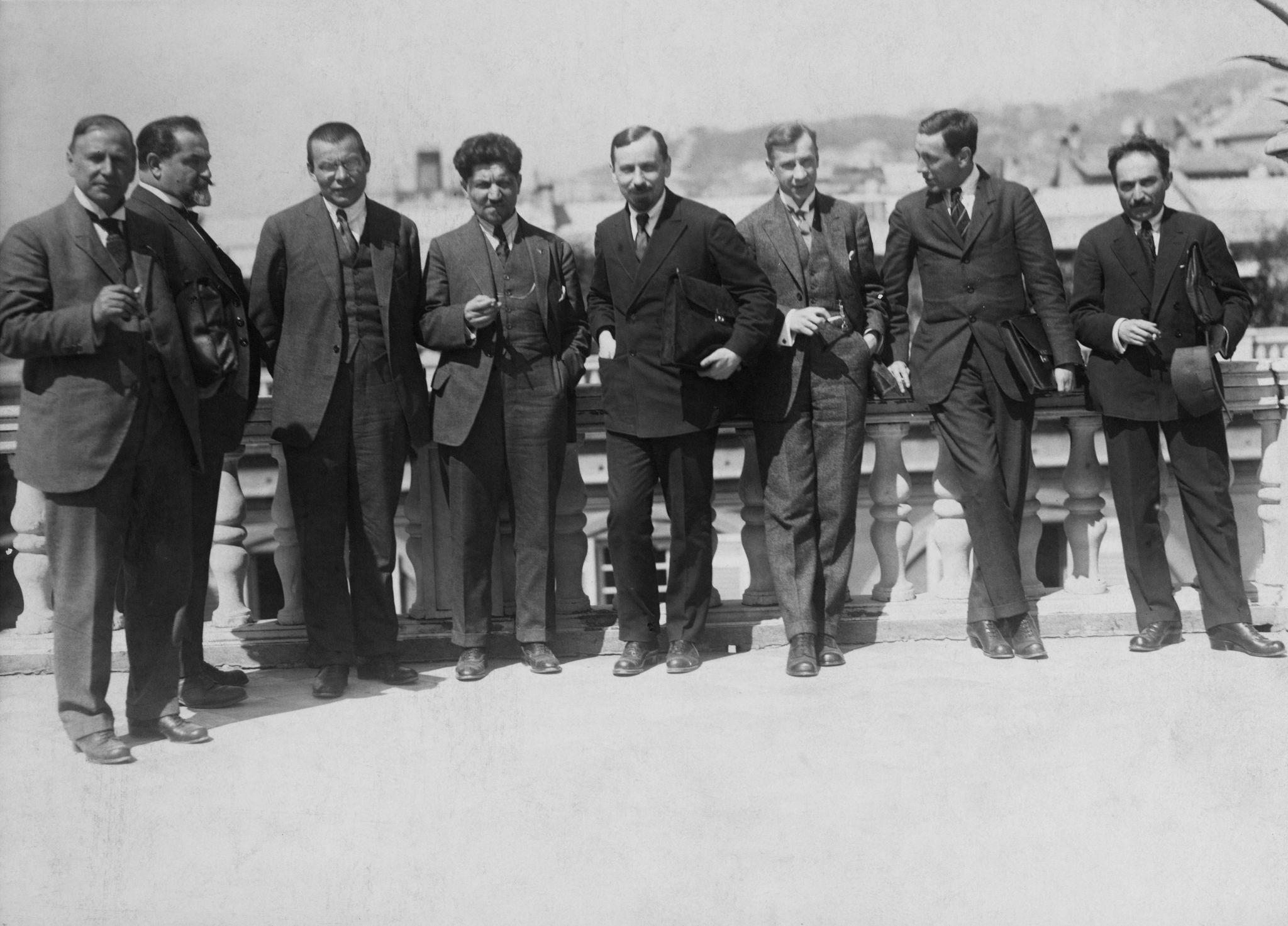
The International Monetary Conference held in Genoa in 1922 adopted a number of “resolutions,” the ninth of which led to the establishment of the gold exchange standard. These resolutions emphasized four essential points:
- When progress permitted, certain participating countries could establish a free gold market and thus become gold centers.
- Participating countries could hold in other participating countries, in addition to their gold reserves, assets in the form of deposits, bills of exchange, short-term securities, and other appropriate liquid resources.
The agreement referred to was never formally signed, yet the proposed system operated between 1922 and 1930. Its primary objective was to economize gold, the world supply of which had not increased at the same pace as prices during the war of 1914–1918. It was therefore hoped to avoid the deflationary effects that a general return to the gold standard would inevitably have produced. England would, on its own account, experience this situation from 1925 onward.
It was also in order to economize gold and reserve it for international transactions that the exclusion of gold coins from domestic circulation was recommended. Convertibility of currencies could be guaranteed exclusively in bullion (gold bullion standard). As seen in the preceding chapter, Ricardo—whose proposal was not followed in his time—had advocated bullion convertibility as early as 1810 for the same purpose of economizing precious metal. Governments could authorize central banks to include gold-convertible foreign exchange in their legal reserves backing note issuance; it is true that these rules of issue varied greatly from country to country, even under the gold standard before 1914.
The immediate consequence of this system was the institutionalization of gold centers and indirectly convertible peripheral currencies. The authors of the Genoa resolutions could have had in mind only sterling and the dollar. Britain wished to promote a system that, while economizing gold, would also draw it more easily toward London, whose revaluation was all the more imperative since sterling’s direct convertibility into gold had to be restored. The Bank of England intervened several times during the 1920s. In his work on international monetary experience, Nurkse wrote that in countries where reserves were constituted largely of foreign exchange, the advice and wishes expressed by experts and financiers from lending countries played a particularly important role in the functioning of the gold exchange standard.
Moreover, this same factor tended to discredit the system in the eyes of certain creditor and debtor countries alike. The inclusion of foreign assets, rather than gold, in central bank reserves came to be regarded as detrimental to the prestige of a great power and even of a second-rank country. For this reason, states whose foreign assets were, in absolute terms, the most significant—France, Germany, Italy, and Poland, for example—considered the gold exchange standard a temporary expedient. This perspective sheds light on the problem of the gold exchange standard and foreshadows the causes of its failure. The evolution of global economic and financial structures between the late nineteenth century and 1920 also explains the system’s ultimate breakdown.
The strategy of the financial centers
Assets deposited in the gold centers could take various forms, and the short-term loans granted by banks in these financial poles increased the volume of foreign credits. As competition between London and New York intensified, concern for maintaining former positions contributed to an expansion of short-term lending. New York was not the only market conducting international banking operations with the support of monetary authorities. Paris also attempted to do so with the assistance of the Bank of France, whose 1930 annual report declared the need to encourage without reservation the international role of the Paris market, particularly the acceptance market. Faced with London’s technical superiority, official backing was necessary for the expansion of operations, both in Paris and in New York, where such activities could be regarded as a “new industry” requiring protection against external competition from a better-equipped country.
Competition between London and New York
Whereas the dominant position of the City was the result of a long historical evolution, the international role of New York was largely a consequence of the war. Before 1914, New York performed within the United States the clearing function that London exercised on a global scale. The enormous needs of the belligerent countries from 1914 onward led them to import American goods. To finance these operations, European countries liquidated part of their long-term claims on the United States, paid in gold, and borrowed dollars. Global demand for dollars emerged and developed at a moment when London’s traditional activities were paralyzed by the war. American bankers then directed their efforts along three lines:
a) Acceptance.
b) The management of foreign asset deposits.
c) Long-term foreign investment.
The future role of New York as an international financial center depended on the success of these three undertakings.