
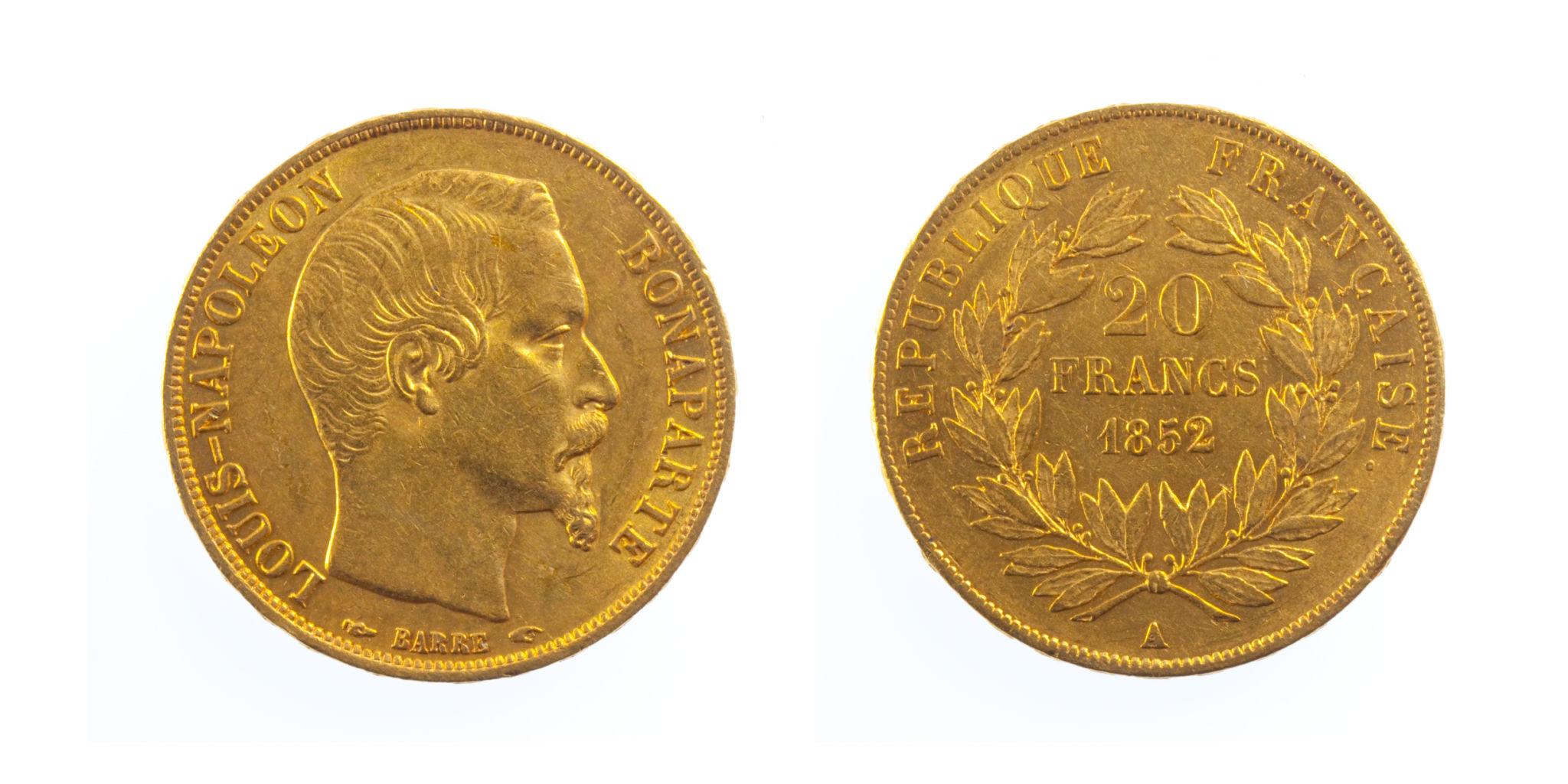
The consequences of Britain’s return to the gold standard at the prewar parity were particularly unfavorable for the British economy, especially because France had previously devalued the franc, reducing the definition established in the monetary law of year XI (March 28, 1803). On that date, France had adopted a bimetallic system granting free coinage of gold and silver and unlimited legal tender to both gold and silver coins. One kilogram of gold with a purity of nine-tenths allowed the minting of 155 coins of twenty francs. The franc therefore contained 322.5 milligrams of gold with a purity of nine-tenths. At the same time, the franc was also defined in terms of silver: one franc corresponded to a specific weight of silver with the same purity.
A law passed on August 5, 1914 suspended the convertibility of the franc. At the end of the war the depreciation of the currency in foreign exchange markets became catastrophic. Before 1914 the exchange rate had been about 5.18 francs for one U.S. dollar and 25.22 francs for one pound sterling. By July 20, 1926, when the currency reached its lowest point, the rates had collapsed to 49.22 francs per dollar and 240.25 francs per pound. The government fell and, on July 26, 1926, Raymond Poincaré assumed leadership of the Council.
Preparing his stabilization policy, the government passed the law of August 7, 1926, through which France entered a regime of gold exchange standard. Article 3 of the law stated that banknotes issued by the Bank of France in exchange for gold, coin, or foreign currency reserves would not be included within the legal limit established for banknote circulation.
This was not the only measure that restored confidence among holders of francs, although the details of the broader Poincaré policy cannot be fully examined here. By December 22, 1926 the exchange rate had strengthened considerably: the dollar stood at 25.16 francs and the pound at 122.25 francs. On that date the government decided to stabilize the franc at this level and requested that the Bank of France buy and sell pounds at the rate of 122.25 francs. Authorities deliberately maintained uncertainty regarding the possibility of a formal legal stabilization, which further stimulated speculation in favor of the franc.
Investors believed that the franc was undervalued and expected a potential revaluation. Acting on that expectation, holders of capital purchased francs. As a result, the Bank of France received large inflows of foreign currency and gold. In 1925 the bank’s foreign exchange reserves amounted to about 13 million dollars and gold reserves to 711 million dollars. By 1928 these figures had increased dramatically to 1.287 billion dollars in foreign exchange reserves and 1.254 billion dollars in gold.
The law of June 25, 1928 formally placed the franc under a gold standard regime, although convertibility was guaranteed only in gold bullion rather than in circulating coins. The system of emission ceilings was abandoned and Article 4 of the law established that the Bank of France must maintain gold reserves in bullion and coin equal to at least 35 percent of the total amount of banknotes in circulation and outstanding current account deposits.
Finally, the franc was redefined as containing 65.5 milligrams of gold with a purity of nine-tenths. Before the law was enacted, Poincaré had declared before the Chamber of Deputies on June 24, 1928 that once legal stabilization had been decreed, the Bank of France would have a strong incentive to convert its foreign currency holdings into gold and would begin doing so immediately.
This decision became the starting point of the monetary tensions with London. Paris now emerged as a center for gold accumulation, and the Bank of France began converting its foreign exchange reserves into gold. Foreign currency reserves, which had reached 1.287 billion dollars in 1928, fell to 842 million dollars in 1931 and to 176 million dollars in 1932. Gold reserves followed the opposite trend, rising from 1.254 billion dollars in 1928 to 2.699 billion dollars in 1931 and to 3.257 billion dollars in 1932.
By 1930 nearly 5,000 tons of gold were stored in the vaults of the Bank of France, representing roughly one quarter of the world’s monetary gold reserves. This development increased the difficulties faced by London and contributed to the eventual failure of the gold exchange standard. Between June 25, 1928 and November 1932 the conversion of foreign currencies into gold increased metallic reserves by 30 billion francs. Yet during the same period the total gold reserve rose by 54 billion francs. The difference, approximately 24 billion francs, represented an inflow of foreign capital whose owners regarded the franc as a safe-haven currency.