
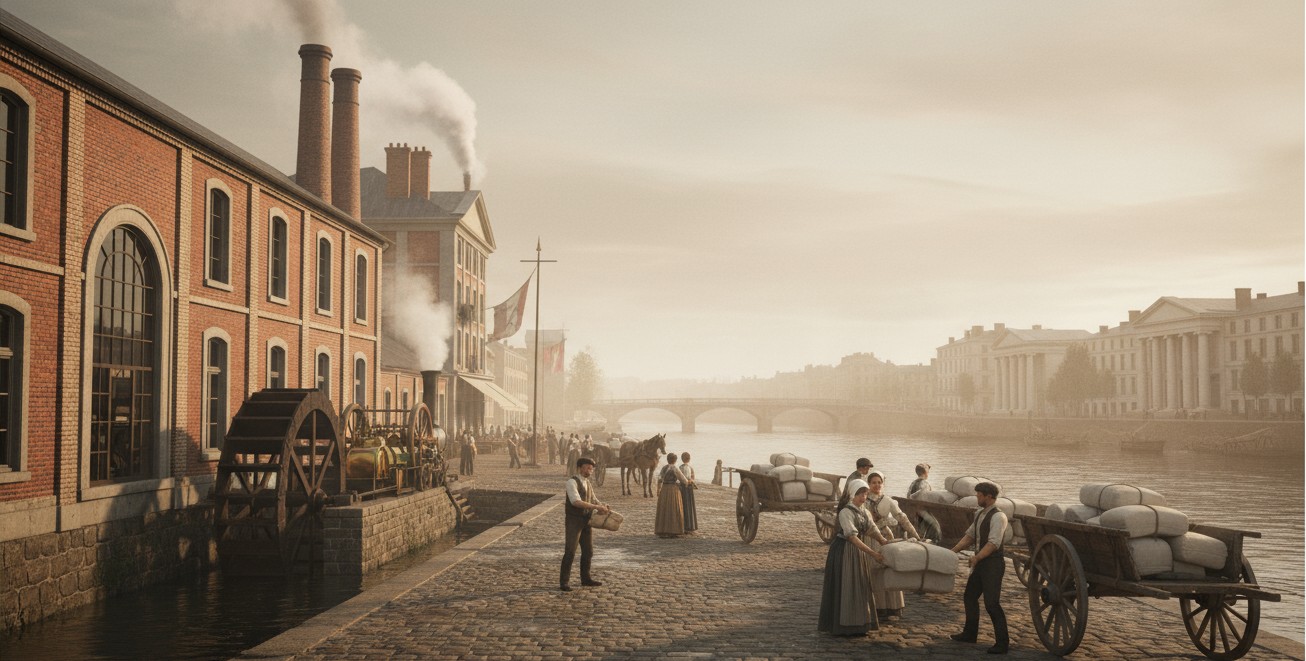
It is not easy to precisely identify the stages of industrialization in France. While authors who have studied English development unanimously place the “industrial revolution” at the end of the eighteenth century, which was discussed in the previous chapter, there are still many doubts and uncertainties regarding the French case. Anglo-Saxon authors generally choose 1815 as the starting point of the industrial revolution in France. But while Clapham argues that industry suffered greatly from the outbreak of the Revolution and the wars of the Empire, and that it was necessary to wait until the Congress of Vienna to enter an era of international peace conducive to development, more recent studies by Dunham, Henderson and Cameron emphasize the economic scope of certain institutional transformations inherited from 1789 and from Napoleon I.
Dunham writes in his Révolution industrielle en France: “Nevertheless, France had not suffered serious losses in human lives or property, and the conditions of peace were not so harsh as to leave the country weakened for long. Its great revolution and the hand of Napoleon had purged it; although they caused damage, they also freed it from impurities that would have hindered its economic progress; its administration and its laws had been modernized and perfected by the Convention and the Empire.” R. E. Cameron, in a recent work dedicated to the economic development of France and Europe, affirms that nineteenth-century European history emerged from two revolutions: one political, the other economic. “The French Revolution destroyed the feudal hierarchy, dispossessed the aristocracy and the monarchy, and proclaimed the right of all men to political freedom and social equality. In Great Britain, the technological changes experienced by agriculture and industry revolutionized the material basis of existence and provided the means by which the ideals of the French Revolution could be put into practice.”
This fortunate synthesis, which did not always produce in social terms the beneficial effects that an overly optimistic extrapolation might suggest, was possible thanks to the crucial, though often overlooked, role that the French played in importing, expanding, adapting, and transmitting to the rest of Europe the fundamental elements of the economic revolution. However, when the study of French economic growth is approached through the already classic works of François Perroux and J. Marczewski, it becomes clear that France’s economic development had begun long before 1815. There was an undeniable gap between Great Britain and France regarding the starting point of industrialization, but it is at the end of the seventeenth century, not in 1815, that the beginnings of industrial growth should be placed.
The driving industries in the first phase of industrialization
As in the English case, the textile and iron industries were the first driving forces in the transition from an artisanal economy to an industrial one.
The textile industry
By the mid-eighteenth century, a rural textile industry already existed in France. An edict of 1792 had granted rural inhabitants the right to manufacture fabrics without belonging to a guild. This edict merely formalized an old practice. Linen and cotton were worked at home with raw material provided by merchants. This type of domestic activity disappeared, as in England, with the introduction of the first machines installed in factories. This transformation began in the second half of the eighteenth century.
Leaving aside the silk sector, for which Jacquard invented the first loom, mechanization methods were imported from England. It was not easy to obtain English machines, whose export remained prohibited for a long time. Nevertheless, a significant amount of technical information was published and thus accessible. Many travelers also went to Great Britain hoping to visit factories and gather explanations about machine operations. Some machines were purchased and exported with licenses granted by British authorities; others were obtained through smuggling. A genuine economic espionage network developed, though its full extent is hard to determine. Some English craftsmen were invited to emigrate in order to share their technical knowledge on the continent. Although this was forbidden and punished with fines or prison, inventors and entrepreneurs often accepted, attracted by the prospect of high profits.
John Kay and John Holker became pioneers of the French cotton industry. Kay first went to France in 1747, settled in Paris, manufactured shuttles, and taught their use to French weavers. In 1749 he received a grant of 3,000 pounds from the government and an annual pension of 2,500 pounds to tour textile centers in Normandy and demonstrate the flying shuttle. Despite official support, the diffusion of Kay’s invention was slow, and around 1790 the French government sought to encourage manufacturers to use his system. Kay and his sons worked in France for many years, always under government sponsorship, which recognized the economic value of the English inventor’s talent.
John Holker, a Manchester manufacturer and Catholic Jacobite, took part in the 1745 uprising. Imprisoned in Newgate in 1746, he escaped before trial and fled to France, where he not only saved his life but also contributed to the development of the textile industry in Normandy by founding a factory in Rouen. He illegally brought skilled workers and machinery from England. With the support of inspectors from the Administration du Commerce, Holker founded his enterprise with French partners. Recognized by the government, he was appointed inspector general of manufactures in 1755 and ennobled in 1775. From 1756 to 1786 he played a decisive role in French textile development, introducing the spinning jenny in 1771 and later establishing factories to produce these machines. Many English families settled in France, founding spinning and weaving mills, including colonies in Bourges. Others, like the Hall and Milne families, introduced Crompton’s mule around 1788.
Water and steam power were first introduced in Alsace. By 1830, while Roubaix had no water- or steam-powered looms, Alsace already had 18,000. The Englishmen Heywood and Dixon set up one of the first spinning mills there using hydraulic power. English influence was also decisive in lace-making from the early nineteenth century, as large numbers of skilled English workers migrated to factories in Calais and Boulogne, causing concern in Britain.
Two French inventors had the paradoxical experience of seeing their machines copied in Britain and then “re-exported” to France. Between 1810 and 1815, Philippe de Girard invented a flax-spinning machine by decisively improving one designed by Kendrew and Porthouse in England. Lack of capital, weavers’ resistance, and the political uncertainties of the late Empire prevented its adoption in France. A collaborator leaked the plans to the English, enabling the Leeds flax industry to develop. By 1835 French manufacturers had to purchase this “English” machine at great expense, although Girard had made it available two decades earlier. Another case was Louis Robert, who invented a papermaking machine around 1799. It was first used in Britain, and by 1815 French manufacturers had to buy it there.
Overall, with few exceptions, France quickly benefited from the same textile production techniques as England. Yet industrial development advanced more slowly in France than in Great Britain. The same lag occurred in other industrial sectors.