
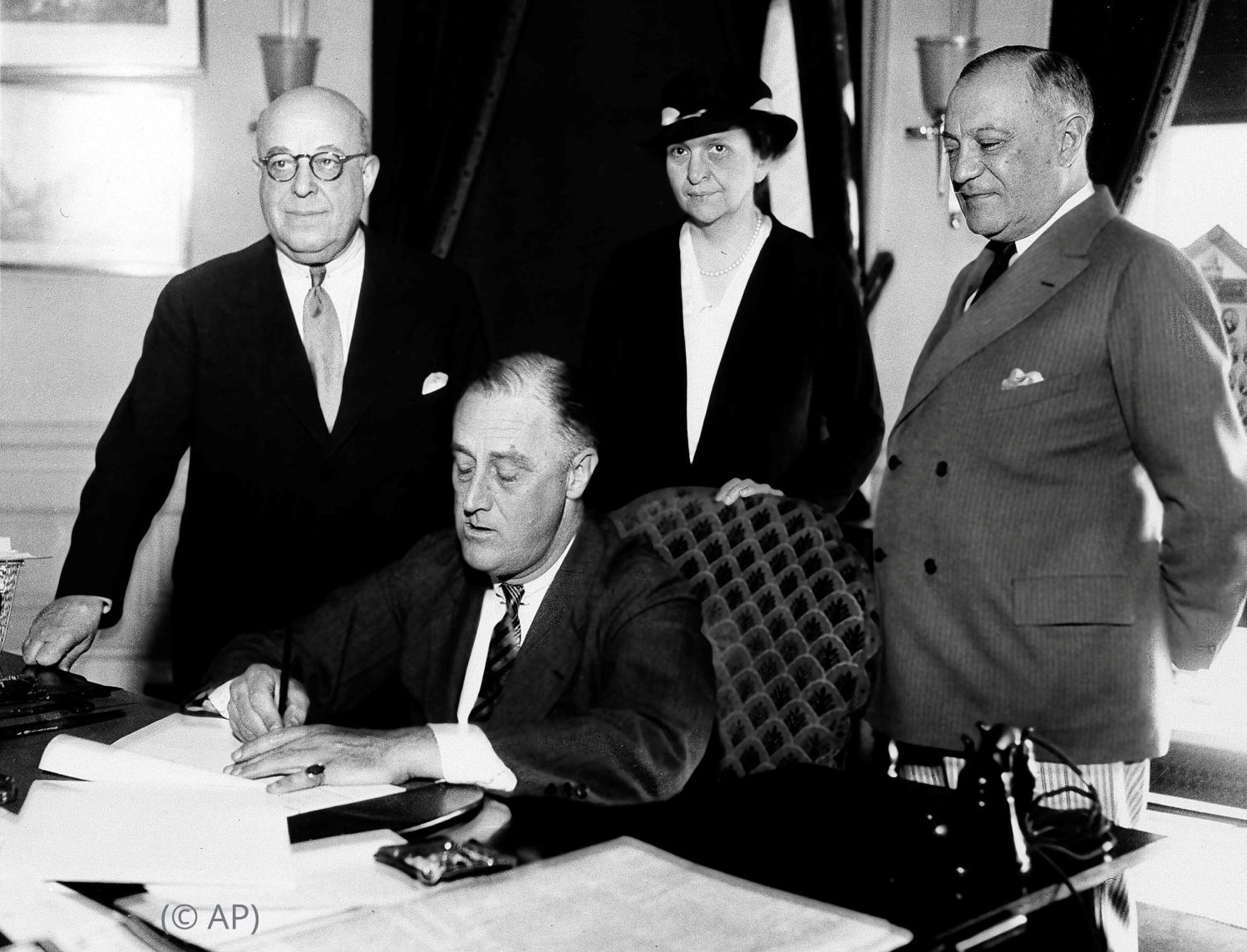
From a social standpoint, the New Deal was beneficial in its humanitarian intent. Aid to the unemployed, by defending purchasing power, could only contribute to maintaining economic activity. Social and economic objectives were therefore fully compatible in a depression. Beginning in May 1933, the Emergency Relief Act created the Federal Emergency Relief Administration, endowed with 500 million dollars to assist the unemployed. The N.I.R.A. later organized the Public Works Administration, which spent—until its abolition in 1942—13 billion dollars in order to create jobs through public works. In 1938, the P.W.A. managed to employ 3.8 million unemployed persons, that is, one third of that year’s unemployed. The P.W.A. did not, in the manner of the Hitlerian economy, direct resources toward the production of goods for destruction. The social consequences of this deflation created favorable conditions for the rise of Nazism. Never will a bad economic policy have cost the entire world so dearly.
France’s Economic Policy
France was affected relatively mildly by the crisis of 1929. Only after the devaluation of the pound did French prices become relatively too high. Devaluation or deflation: these were the two alternatives. Faithful to the gold standard and to fixed exchange rates, France chose deflation and would quickly lose the advantages gained at the time of the 1926 devaluation. The deflationary experiment continued until the arrival of the Popular Front in 1936. Rising unemployment accompanied falling prices; profits declined; production costs fell less rapidly than wages; discontent was widespread. Farmers were the main victims of the fall in prices. The global depression, combined with deflationary policy, placed several credit institutions in difficulty: Crédit Foncier du Brésil, Banque d’Alsace Lorraine, and Banque Nationale du Crédit. Scandals broke out that revealed collusion between certain politicians and the business world. The Stavisky affair was the most famous: after the failure of the Crédit Municipal of Bayonne, its director, Stavisky, died under mysterious circumstances. Distrust of the regime continued to grow; the country was on the eve of February 6, 1934. Growing risks of devaluation accelerated capital flight, capital exports, and gold outflows. The prospect of a Popular Front victory in the 1936 elections was hardly reassuring to capital. In July 1935, Pierre Laval became President of the Council and pursued the policy of deflation, except with regard to agriculture, the sector most severely affected. Urban discontent only increased, and in January 1936 Laval was overthrown.
From April 1936 onward, Léon Blum headed the Popular Front government. The first two major decisions concerned, on the one hand, wages and, on the other, the currency. In response to strikes and the occupation of factories by workers seeking to prevent a lockout, Léon Blum convened representatives of labor and employers at Matignon on June 7 and 8, 1936. From this conference emerged a set of agreements (the Matignon Agreements), ratified on June 11 and 12 by Parliament. Their content satisfied key demands: wage increases; paid annual leave of fifteen days; the recognition of workers’ delegates; and the principle that working conditions would be determined by collective agreements negotiated between employer and worker representatives, either at the firm level or within a given industry. The reduction of the workweek and the implementation of a major public-works policy aimed to reduce unemployment. Unfortunately, production soon declined, as an increase in productivity could not be achieved quickly. Rising production costs were immediately passed on to prices, and the increase in the cost of living soon outpaced wage gains. Social unrest persisted. This rise in prices heightened the urgency of the foreign-trade problem.
By the law of October 1, 1936, the franc was detached from gold, and it was specified that its new definition would be no less than 43 mg and no more than 49 mg. While freedom of exchange was maintained, the law created an Exchange Stabilization Fund endowed with 10 billion francs in gold and foreign currency, whose function was to offset spontaneous movements of supply and demand and keep the franc’s rate within its legal limits. This “Auriol” franc was devalued by 25% to 34% relative to the “Poincaré” franc. This devaluation soon proved insufficient, and flight from the franc continued. On June 30, 1937, the Chautemps government carried out a third devaluation of the franc, and in May 1938 the Paul Reynaud government devalued it a fourth time.
In 1937, when full employment had virtually been achieved, national output reached only 82% of its 1929 level. Several reasons explain this phenomenon: demographic stagnation; the beginning of a return to the countryside by part of the industrial labor force; and the forty-hour week. This last measure, social in character, did not yield the expected results in terms of overall economic mechanisms. Those who benefited most were manufacturers, who quickly passed higher costs on through prices; rentiers and the elderly, by contrast, were victims of rising prices.