
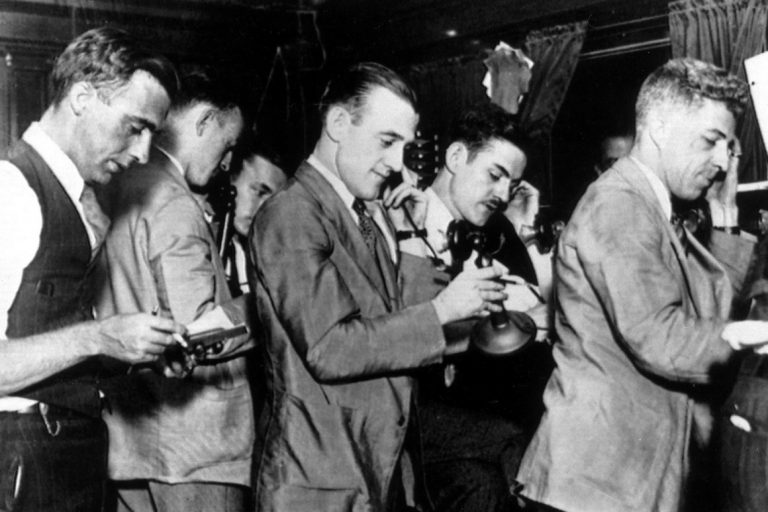
It is when funds are abundant, when profits seem ready to be harvested, and when everyone feels the urgent desire to get ahead of his neighbor, that major frauds have almost always been committed, generally when the market is rising. Neither the financial and banking structures nor the great capitalist interests alone would have been enough for credit policy by itself to drag the United States toward the dangerous peak of October 1929. For their part, the monetary authorities proved incapable of acting to prevent the crisis. It is true that at that time, even more than today, any direct intervention by the central bank or the government appeared contrary to the principles of liberal capitalism. We shall leave Galbraith responsible for this severe judgment: “At that time (1927–1929) the Federal Reserve Board was an organ of spectacular incompetence.”
The causes of the depression
We do not intend to analyze in detail the many causes of the depression. Studies on this subject abound, but authors often disagree completely. We will therefore limit ourselves to extracting from the preceding historical account the least contestable elements among the causes of the depression. First, let us recall that this depression began in the United States and then spread to the rest of the world. It is the deepest ever experienced by the great industrial capitalist countries. It is the first time since the Industrial Revolution that the capacity of the capitalist system to return to equilibrium has been called into question. The situation was all the more serious because, since 1917, the collectivist system had emerged in Russia and, after a period of difficulties, was developing while escaping the world crisis. At a time when unemployment and misery were rapidly spreading, the socialist movement gained strength and often appeared as the only possible remedy. For this reason, the ruling classes had an interest in adopting the necessary measures to relaunch the economy, but to do so they needed to know what had to be done.
This inadequacy may have delayed the adoption of appropriate measures and—what is more serious—may have supported economic policies more likely to deepen the depression than to curb it. The first depressive factor we must consider is therefore this mismatch between economic thought and policy and the reality of the crisis. However, this is only a minor factor compared to the other causes, which involve all cyclical and structural variables. Never before had the economic situation—resulting from the behavior of all economic units after the 1929 crash—been so bad. Psychological factors worked in favor of depression, just as before the crash they had worked in the opposite direction. The evolution of world structures favored the international spread of the crisis. Finally, the failure of international cooperation and protectionist policies, by slowing trade, added their weight to the depression.
The errors of Liberal Orthodoxy
Capitalism functions poorly because it is prevented from functioning. Attempting to end the depression only prolongs it, because rigidities are introduced into market mechanisms. Automatic and spontaneous adjustments do not take place due to state intervention. In 1963, an American author deemed it appropriate to revive this “ultra” liberal thesis in a book devoted to the U.S. depression of the 1930s (M. N. Rothbard, America’s Great Depression, New York, Van Nostrand, 1963). For these authors, the depression would have lasted less and been less deep had the system been left to run its course. Their causal analysis of capitalist fluctuations between the late nineteenth century and 1930 can be summed up in three words: “state intervention.” Unfortunately, liberals accept certain monetary and budgetary tools only when they are used to restore “equilibrium.” This “restoration” always requires sound money and a balanced budget, even at the cost of raising taxes and reducing public spending in the midst of a depression.
Beginning in November 1929, President Hoover decided to reduce taxes and asked businesses not to lower wages and to maintain investment spending. Economic advisers and both political parties protested against these decisions, and the Democrats demanded budget balance just as strongly as the Republicans.
In 1932, Roosevelt himself was not immune to monetary orthodoxy, declaring in a speech in Brooklyn: “Sound money is an international necessity, not an internal consideration for a single nation.” A year later, at the London Conference, he defended a radically different position after devaluing the dollar. Faced with the consequences of the 1929 crisis, economic thought seemed incapable of inventing new remedies quickly. Rather than analyzing the evolution of the capitalist system in depth to better understand its mechanisms, the easy solution was to say that it would function properly provided that nothing changed.
Moreover, certain measures—such as budget balance—could deepen the deflationary trend by reducing aggregate demand. The United States did not have a monopoly on these errors: in 1931, the British government created a commission to study “the state of national finances.” The report of this May Committee stated that balancing the public budget at all costs was essential. Unemployment relief funds also needed to be balanced, and it recommended reducing unemployment benefits. The Labour government intended to reduce them, and only under pressure from the Trade Union Congress did it reverse the decision. At that time, there were nearly 3 million unemployed in Great Britain. Keynes is said to have remarked of the May Report: “It is the most idiotic document I have ever had the misfortune to read.” The Keynesian revolution had not yet taken place.